Organic farming needs no artificial inputs of fertilisers and sprays to grow all the food we need. These harmful chemicals damage and degrade soil releasing carbon. All of earth’s soils have all the nutrients plants need to grow strong and healthy when soil is “alive”
At Hilltown Organics, fungi play a key role in growing all the range of crops on our challenging soils on the edge of Dartmoor. Fungi cycles nutrients, keeping carbon in the soil and holding onto precious moisture during dry periods. A single handful of “healthy” soil contains in excess of 500 species of fungi. Fungi dominate the total biomass due to their collective mass in a healthy soil. It is a network of cells living within and throughout all living landmasses on Earth and are able to breakdown rock particles with their strong acids releasing vital minerals for plants missing in today’s industrial food. Industrial farming with chemicals kill off ecosystems in soils so is dependant on adding further chemicals to keep their crops alive.
soil economy
trade sugars for minerals
More muscle than heavy machinery
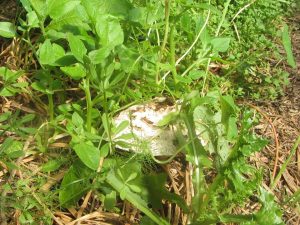
market garden fungi
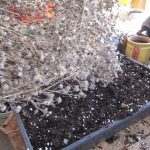
hay compost fungi
birds nest fungi
The mycelium of the soil fungi is a vast body in organic soils. If mycelium networks were unravelled, 8 miles of these cells would be found in a cubic inch of soil (Source: Mycelium Running). Fungi helps to increase nutrients available to plants, improve water efficiency, reduce erosion by acting as a cellular sponge, and promote root growth by adding oxygen to the soil and releasing nitrogen, phosphate, and other micronutrients. They also provide resistance to some plant pathogens unique to organic soils. Mycelium also has a “cushioning” effect able to resist a certain amount of compaction from agricultural equipment and is also an important food source for many beneficial soil invertebrates which will be food to support declining animal and bird populations further up the food chain.
COP26. Soil degradation is one of the big climate change drivers we don’t see being mentioned very much by governments and media, industrial agriculture has severely damaged soils with its chemicals over decades releasing its carbon once locked up as “humus” from precious organic matter built over centuries. Damaged humus is broken down and released as carbon gas. It has been very sad that world leaders have given soil barely any attention at COP26 with no agreements on mitigating soil damage, instead it has been a triumph for agrochemicals and fuel industry, which governments keep protecting such is their strong and powerful lobby.
What can we do as individuals? Get behind and support organic farmers who always put soil health first building soil fertility naturally. They are leading the way in sustainable food production and carbon sequestration. New tools on the market, refractometers, confirm that organic food contains greater amounts of trace minerals than industrial food due to the rich life in their soils. Brix measurements is a direct correlation between a plant’s Brix value and its taste, quality, and nutritional density.
One last fact. Fungi is important to our general health and wellbeing, not only do they provide plants with key nutrients but they also nourish our health. Getting out in nature, in the chemical-free meadows and woods helps get billions of fungi spores on our skin, hands and face, which are beneficial for us providing some skin care and protection from germs and pathogens.
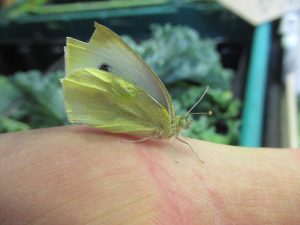
Over the years the Harvest farm shop has had all sorts of visitors from the animal kingdom including a goldcrest bird, duckling, a frog and various moths and butterflies. Today in the shop we had 2 visitors from the local world of insects, winged cousins, a small cabbage white butterfly and a close relative of butterflies, a poplar hawk moth.
The impressive hawk moth was brought into the shop for an identification by a friend of Harvest and the butterfly emerged from the batch of kale delivered this week.
There are about 59 uk butterfly species but there are an incredible 2500 species of uk moth with the hawk moths being amongst the largest.
Cabbage white are considered by gardeners pests of brassica, or the cabbage/mustard family.
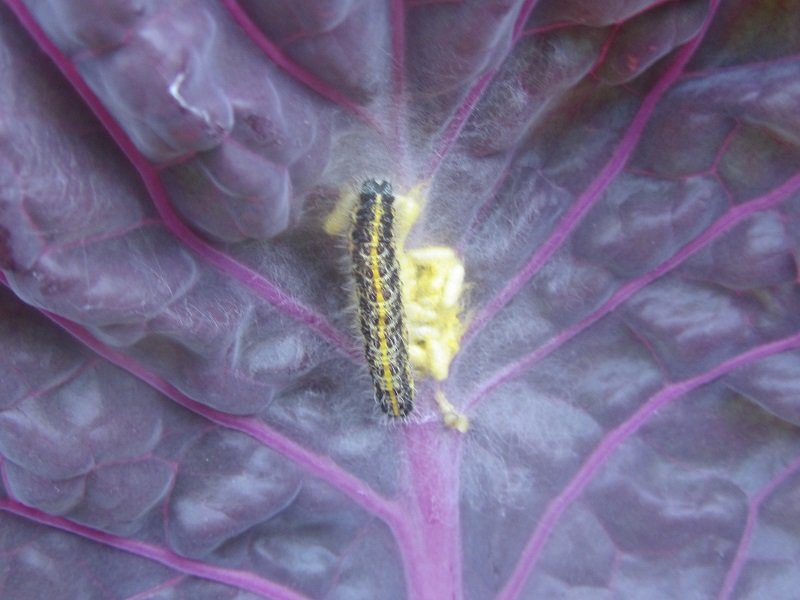
A few caterpillars of both butterflies and moths can cause some damage to leafy crops, It is the time of year when cabbage white seek out members of the brassica family on which to lay their eggs. There are 2 cabbage white butterfly species which are considered pests of brassica, the small white and large white. Gardeners and growers are most familiar with the large white as they lay numerous eggs which hatch out into greenish caterpillars, these eating machines can render a cabbage, kale or cauliflower looking like a skeleton, In most cases the damage is brief and the plants recover fully after the caterpillars pupates.
Organic and agro-ecological farmers and gardeners do not use chemicals such as powerful pesticides which also harm friendly wildlife and the health of the soil, instead they build good soil health and provide habitats and wildlife corridors for nature and the many predators of pests, particularly encourage parasitic wasp which seek out their caterpillar prey, the cabbage white caterpillar and lay their eggs on them. The wasp larvae hatch and begin to feed on the hosts insides of the caterpillar avoiding its vital organs until it is ready to morph into an adult wasp when it eats its way out and pupates. The predated caterpillar will never reach the butterfly stage so helping to keep things in balance.
The female cabbage white locates the brassica host food plant to lay its eggs by tasting for the mustard taste of the plant with its feet often flitting to a few cabbage plants together to choose a site to lay its eggs. Brassica planted with other plant species in a polyculture can confuse the cabbage white and reduce potential damage. If the cabbage plant is established and healthy, it will fully recover after being decimated by caterpillars. Gardeners who want to avoid any damage to the cabbage patch often use a physical barrier such as netting or enviromesh to keep pests off. Beware tho, netting can be lethal for other wildlife such as hedgehogs who will easily get entangled in netting and die.
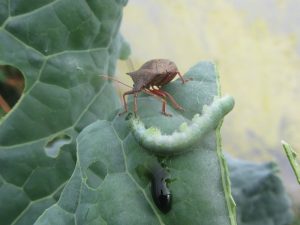
Another predator to the cabbage white caterpillar is the less known carnivorous spiked shieldbug, the bug devours its victims by sucking out its body juices through its spiked mouth part.
Moths and butterflies are a vital food source for bats. Moths, butterflies and caterpillars are eaten by many other animals including other insects, spiders, frogs, birds, toads, lizards and mammals such as bats, hedgehogs & shrews. It may come as a surprise that the large cabbage white butterflies have evolved to be toxic to most birds and this is why robins, blackbirds etc leave them alone so this is why the parasitic wasp is an important predator.
As with almost all garden friends, one of the best habitats for wildlife is a patch of undisturbed, unmown nettle patches, all the better if there’s a pile of rotting logs among it.
One butterfly which often gets mistaken for a cabbage white is the orange tip butterfly which appears in the spring. The food plant of the orange tip caterpillar is the pretty meadow flower the cuckoo flower. The male has the bright orange tips to its wings where this species gets its name from but the female has plain black and white wings.
So much of the natural world’s ecosystems have been damaged by industrial farming and the over use of chemicals that insects have been in decline, Harvest Workers Coop only work with farmers and producers who farm organically without chemicals and without artificial fertilisers and who care for the environment.
Harvesting of winter vegetable crops continues despite the inclement wet weather. Every winter differs from the last. This winter has been a real challenge for farmers and their pickers with the constant wet and windy storms coming off what was a wet soggy autumn for getting their crops off the field and into the packhouses. This poses risks to soil health and the carbon locked up in it.
Small scale, regenerative farms and market gardens which supply our Harvest Farm Shop prove to be quite resilient due to their scale and diversity in what ever the elements sends their way, in extremes of wet weather, fewer nutrients are leached from organic rich soils and they are able to infiltrate more rain water due to greater numbers of earthworms which make their burrows deep into the soil profile which helps mitigate flooding.
Climate change news has been hitting the headlines now for some while and is one of our greatest concerns for our future. There are many ways we can all do our bit to combat climate change, our food choices are one of them. What we put on our plates 3 times each day has a direct impact on how much carbon is stored or lost from soil. When consumers source food produced by organic and regenerative farming methods, they are helping keep and take down carbon from the atmosphere into the soil. The more organic matter (om) soil contains, the more life is supported and carbon is sequestered.
The least soil is disturbed from ploughing, rotavating, harrowing, the more carbon they can hold onto. Heavy soil cultivation and compaction damages soil structure and the balance of life within the soil. The more soil is disturbed, sprayed and artificially fertilised, the more carbon is lost to the atmosphere and nitrate pollutants are lost down river. No dig/till and regenerative farming is showing it has the solutions to locking and holding much more carbon than any conventional system which continues to degrade soil. Two of our local suppliers have been 100% No dig/till farmers from the outset, Hilltown Organics and Down farm, our other organic local suppliers Shillingford Organics and Bishops farm practice minimum till and some No till on their poly tunnel crops, never ploughing and leaving soil bare over the winter which is the worst thing that can happen to soil.
The weather has severely impacted the 2019 end of season potato harvest, one of our potato suppliers Shillingford Organics has part of their crop still in the ground to harvest which is usually out of the ground and in storage by October. Shillingford are currently supplying us Orla and Red Rudolf, both varieties are multi-purpose and have outstanding taste. They are firm or slightly waxy suitable for roasting, baking and boiling but equally good for chips or in salad.
Carrots and parsnips have been coming from bishops farm who pull by hand which minimises soil damage. Big scale operations dependant of large scale heavy mechanised harvesting severely damages soil which lose large amounts of carbon and nutrients to the air or down stream.
Still very much in season, delicious and in the shop are Leeks, Swede, Parsnip, Purple Sprouting Broccoli and Cauliflowers.
We still have Jerusalem Artichokes in stock which is something unusual to many but favoured by those who cannot eat potatoes, they are a tuber harvested from the soil during the winter and related to Sunflowers. Make an alternative root mash using some Jerusalem Artichokes, Swede and Parsnip.
As we head toward spring, the vegetable growers are planning their next crops and usually start sowing their first seeds in propagating houses around St Valentines day, that s when the days start to get significantly longer and warmer.
The No Dig farmers don’t have to wait for the soil to dry out to start planting and seeding as they don’t have to plough or cultivate, their previous crops are removed and composted and they can get straight on with the planting at the right time. They can do this because they are not running over the ground with heavy machinery which compact and damage soil structure and they don’t allow weeds to grow. The beauty of No Dig is when soil is left undisturbed, the weed seeds all remain in the ground out of site of daylight so over time, there is fewer and fewer weeds. The compost made from crop residues are applied to the surface of the soil in the winter further protecting the soil.
Thank you to the amazing Fred Groom of Devon’s new seed company, Vital seeds https://vitalseeds.co.uk/ for reminding us of the importance of them and for a wonderful seed saving workshop. Vital seeds have been supplying Harvest farm shop this season with their range of seed lovingly packed in paper envelopes and no plastic including many varieties you won’t find in standard garden center display racks.
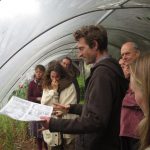
Fred is clearly passionate about his work and fascinated with working with plants throughout the whole life cycle. Most of us only ever get to see the vegetable as it appears in the greengrocer, supermarket or even in the the garden but these plants have a second life if left to grow to flower and seed. We were shown the basic techniques on when and how to harvest and store seed through preparation by fermenting, screening, drying and/or winnowing with very basic everyday household objects like sieves, bottles and even a fan.
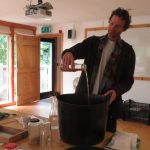
Fred from Vital seeds demonstrating the technique to strain tomato seed which has been allowed to ferment for a few days which aids the process
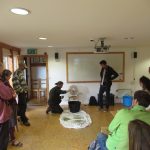
Using the fan to separate the chaff from the seed, the heavy seed falls in the bucket as the chaff is blown away
Read about Freds passion in an interview with Fred Groom https://www.seedsovereignty.info/an-interview-with-fred-groom-from-vital-seeds-in-devon/
Seed is where pretty much all our food comes from, (even varieties of apples and potatoes started off as seed). For 1000s of years, seed exchange was a big part of local economy, rural life and tradition. Farmers and communities valued, cherished, saved and shared seed from year to year, but today farmers do not save seed and almost all agricultural seed is owned by just a few global chemical companies, this has in part resulted in the loss of 95% of food seed varieties and their unique genetics which once gone, is extinct forever, those genes can never be reclaimed.
Today, just 4 global chemical companies control most of the agricultural seed varieties that are either F1 hybrids or genetically modified which have patents and property rights stamped on them meaning literally they own the food on your plate even after you purchased and prepared your meal for the table, also it is illegal to save seed from them in most parts of the world.
Thankfully there are a few amazing small companies like vital seeds, or the real seed company, and seed cooperative to name a few who are keeping alive what’s left of our seed heritage and only grow and sell open pollinated (OP) varieties for us to buy and because they are OPs, this means we can save seeds for ourselves if we wish to.
Have fun growing your own. Other good UK seed companies to source organic and heirloom seed. Including real seed company & seed co-operative. When you buy seed from these small companies, you get the best graded out seed which is not always the case from bigger companies. Look out for the open pollinated varieties if you grow your own
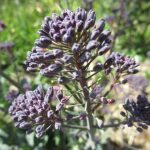
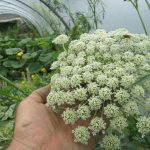
What do you think about when we say brussels sprouts? Perhaps the round green buttons on our xmas dinner plate. This plant is a brussels sprout plant, the flower stems emerge from each of the unpicked sprout on the stem to produce this wonderful display in April/May before it goes on to set seed in the summer
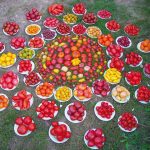
This is what diversity looks like. all these exciting tomatoes are different. This is an image from Kokopelli seeds. All these tomatoes have been threatened with extinction due to pressures from big seed companies trying to control seed through new laws
‘Open pollinated’ means plants breed naturally like wild populations which can evolve over time and adapt to soil, pest, disease and climate conditions, something we will need as our climates are clearly changing whether we believe man made climate change or not. (F1 hybrids can’t do this as you can’t save seed from them and never come true)
Something often overlooked making food choices when were busy is who grew the veg, what seed was used, which company supplied the seed, was the seed treated with pesticide (non organic seed is often treated), were they Hybrids. In almost all cases, veg from the supermarket will be hybrids and if conventionally grown, coated in a pesticide. Seasonal veg grown by our farm shop local suppliers try to support small scale seed companies.
Most of us are familiar with purple sprouting broccoli as in the picture. These delicious purple buds if left on the plant would each open out into yellow flowers. Yellow flowers from the cabbage family attract great numbers of pollinating insects, bees, flies, beetles, butterfly & moths
This is some saved seed of pentland brigg by a Harvest farm shop supplier, an open pollinated variety of kale which was once commonly grown but now rarely grown
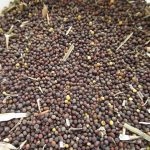
All brassica seed looks like this, each tiny round seed will produce a new plant
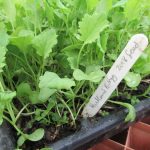
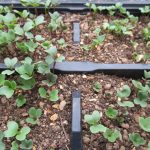
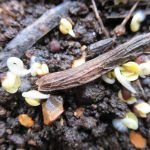
Kale seed germinating
All brassica seed looks like this, each tiny round seed will produce a new plant
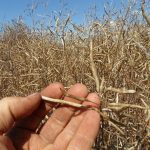
Kale seed ready to process. They flower and seed in their second year
Did you know that most of the agricultural and garden seed sold and planted in the UK is actually produced many thousands of miles away due to our British climate being too damp and not so suitable for large scale seed farming, seed largely comes from countries with drier climates but also cheaper labour.
Big global corporate seed companies don’t like OPs, they have been poorly maintained by them as they don’t make a lot of money and tempt us to buy their F1 hybrids. Unfortunately, many wonderful OP varieties with lovely flavour, size, resistance to pest and disease etc have been dropped from seed catalogues in favour of F1 hybrids and lost for ever. F1 hybrids are far more expensive to buy and companies who own them know that you’ll be back next year to buy more as you can’t save seed from them, some are even bred to terminate and don’t produce a seed at all. Putting the control of seed in just a few chemical giants seems perilous having total control of the food we eat. What’s to stop them from replacing Hybrids with genetically modified seed technology which is still untested on human health. Many arable crops like maize corn, soya, rape seed oil, cotton have been gene modified to be resistant to glyphosate herbicide and can be used multiple times only killing the weeds around them, there is increasing evidence this chemical is linked to many chronic diseases, including cancer and to the effects to soil ecology, wildlife and water pollution.
It is critical to dry seed really well and store in a cool dry place. Paper envelopes are ideal as seeds are living breathing things. Plastic containers can result in seed going mouldy.
Packing lettuce seed for storage
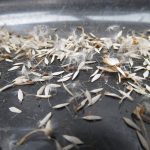
Lettuce seed showing the dandelion parachute
The kitchen sieve is a usefull tool for clean and separating chaff, here the lettuce seeds are hanging from the dandelion like parachutes
Lettuce are one of the easy veg to save seed from, they are self fertile and not affected by inbreeding depression (genetic degredation) One or two lettuce left to seed doesn’t take up much space and would probably produce enough seed for a whole allotment. A lettuce head full of seed being shaken straight into compost rather than being stored
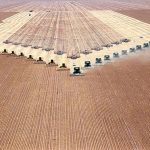
This is where much of the seeds for aniimal foods comes from which feed europes livestock like poultry, dairy and pigs shipped all the way from great expanses of deforested rainforest regions in south america. Here 30 combine harvesters harvesting soya in the picture, most certainly genetically modified resistant to glyphosate weed killer called ’round up ready’. Other consequences of clearing rainforest to grow animal feed is extinction of wildlife species, soil degredation, carbon sequestration losses from tree removal, pollution to amazon river, localised and global climate change and forced displace
Check out Vital seeds online shop where you will find a greater range of vegetables seeds or pop into our small farm shop to see what we stock, we do our best to support and prioritise small scale growers who grow from or save OP seeds
We still have lots of amazing tasty nutrient dense organic local roots, but there is only a few days left to get what we think are the tastiest local chunky carrots around grown in rich Red Devon soil from award winning farm Shillingford Organics. We will have Bishops farm parsnips and Shillingford Organics tasty swedes, potatoes & beetroot still for a while.
Whether mashed, roasted, chipped, stewed, soup, steamed or grated raw, all can be cooked with their skins left on.
Many essential nutrients are concentrated in the skins of roots and eating fruits and veg unpeeled whenever possible grown from healthy soils is great for gut health. Peels are a rich source of fibre, vitamins, minerals, micro nutrients and antioxidants making the skin one of the most nutritious parts of the plant. Because they’re grown without chemicals, they can simply be washed and cooked.
Non – organic carrots are one of the most heavily sprayed crops today and just washing fruit and veg is not enough to remove wax coating, insecticides, herbicides or fungicides readily used on crops such as carrots so it is wise to soak them in baking soda and water for 15 mins before scrubbing well or peel them but I doubt pesticides can ever be removed.
Healthy organic soils rich in soil Carbon are teaming with a diversity of life, the soil food web of life is where trace elements and minerals are made available to the plant in a soluble form by soil life or traded via soil fungi directly into plant cells in return for carbohydrates/sugars, this process is suppressed under non organic industrial farming methods and why non organic sprayed food is partly lacking in essential nutrients which has been well documented. Also modern plant breeding of vegetable varieties that are bred to crop at the same time, look the same, same shape, same size to fit the supermarket cosmetic requirements can only be achieved by inbreeding and narrowing of genetic diversity at the cost of plant nutrition. Missing nutrients in veg is replaced by water.
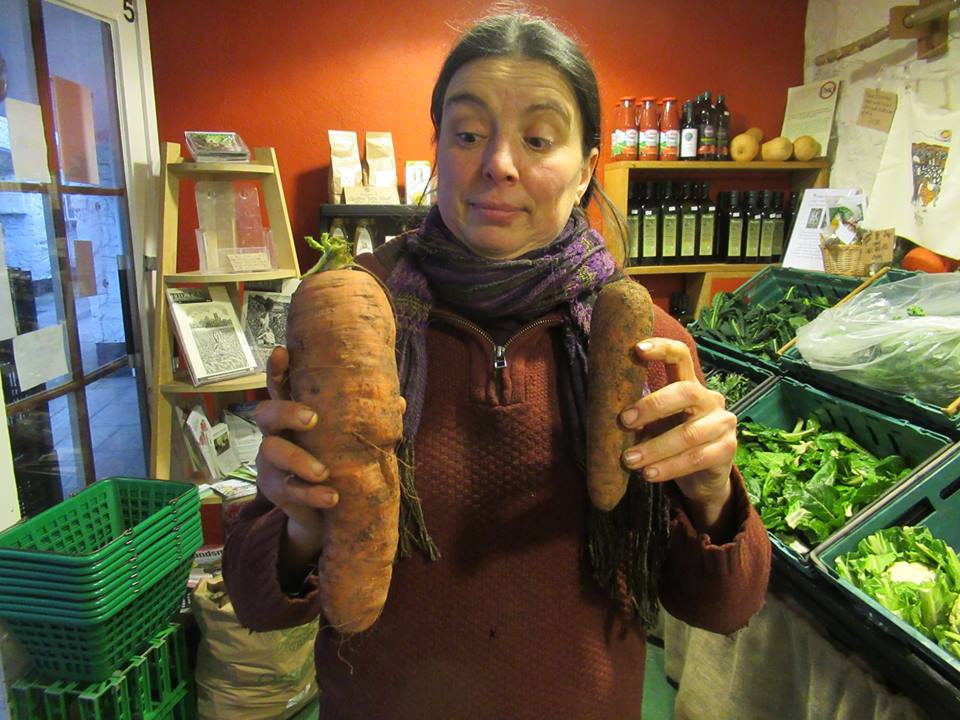
The photos show organic roots stocked by Harvest with character of all colours, shapes and sizes. The practice of grading out mountains of veg and left on the field to rot because of tight supermarkets cosmetic controls is wrong and a waste of good food. Good for health, eat the rainbow of colours
Carrot people of all shapes and sizes. Carrots come in all shapes and sizes but the wonky ones usually get rejected as waste so these fun shapes are rarely seen outside the farm gate . Note the one giving a piggy back. these were from Shillingford organics.
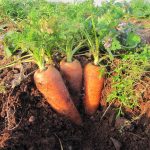
It’s not just about the crop, these over wintering carrots were harvested in late winter, all around the carrots are weeds which happily grow together in the winter, the one in flower is red dead nettle which will be visited by early emerging pollinators like bumble bees on warm late winter sunny days when they are active. Any weeds covering the soil in the winter are moping up surplus nutrients and protecting the soil from weather elements and feeding soil life energy from the sunshine increasing soil carbon.
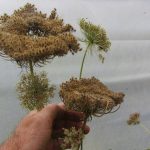
Carrots are biennial and produce beautiful flowers in the second year if left in the ground. Looking like cow parsley they are of the same family and adored by insects.
Carrot flower seed heads producing seed. Saving carrot seed is relatively easy but only open pollinated varieties produce viable seed true to type for the next generation.
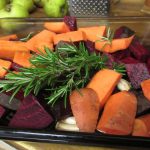
Chunky carrots and beetroot ready for baking with their skins on.
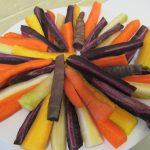
Carrots were not originally orange and now come in a range of colours. Purple carrots were the norm but in the 17th centuary, dutch growers managed to cultivate from yellow and white ones into the orange ones we are familiar with today. we still have some rainbow carrots at the shop.
What does every one know about how spuds are grown and how crop Desiccation occurs prior to harvesting in this modern age of Agriculture ? Long gone are the days of picking them up by hand behind the old potato digger on big farms. As ever Industrial Agriculture forged ahead in the chemical direction not thinking about nature, soil degredation or peoples health. The more the mechanisation, the more the compromises and chemical applications. Harvest Workers Co-op organic farm shop only sells Organic potatoes, all from Devon at this time and all really tasty varieties grown in soils teaming with life which attract so much wildlife to those farms.
Under intensive industrial methods, many potato crops are desiccated just before harvesting using weedkiller. How does anyone know if the potatoes have been sprayed or not on the supermarket shelves? they all look the same side by side. there’s no traceability or information on that. Other crops that are commonly desiccated around the globe in the same way are wheat, soya, oil seed rape, oats, peas, beans. The practice of Desiccation is prohibited under organic certification but as organic farmers know, chemicals are harmful to soil life which they depend on to build soil fertility. Here is a link to Wikepedia explaining Desiccation
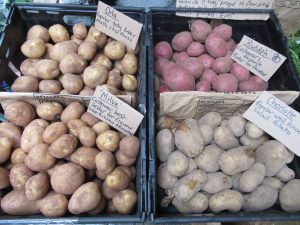
Really good flavour potato varieties from Shillingford Organics & Cyril Blackmore, Devon, available now at Harvest Workers Co-op organic farm shop in #Okehampton. Orla, Milva, Rhudolph & Charlotte. Never sprayed and never stored with growth inhibitor hormone.
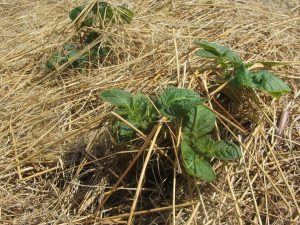
Spuds on a smaller scale can be grown using the no dig method. Compost is best but here we have planted through a hay mulch, the risk is there will be some slug damage but we have found this method works well for us at Hilltown Organics Helping to clean a patch for the following Autumn crop
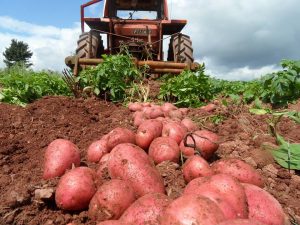
New potatoes harvested at Shillingford Organics, note the dark crumbly health of the soil rich in life, no artificial fertilizer has been used on this field since conversion around the year2000. Soil samples show soil fertility now far higher than when the farm turned organic, proof you do not need the fossil fuel fertilizers.
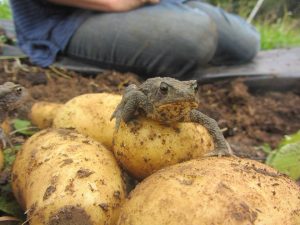
Healthy soil attracts a whole host of wildlife. Toads in among Hilltown Organic spuds last year.
Potatoes benefit form a symbiotic relationship with soil fungi called Mycorrhzae fungi, fungi are destroyed by fungicides in conventional systems.
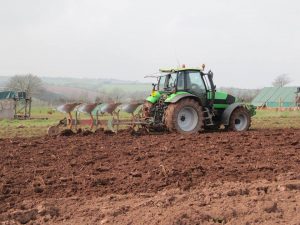
The soil requires ploughing to plant potato tubers, Here is Mike at Shillingford Organics prepping soil for the following crop. Mike tries to plough shallow and minimal till as most of the soil life is in the top few inches, soil disturbance has a negative affect on soil health and mike skillfully minimises soil tillage.